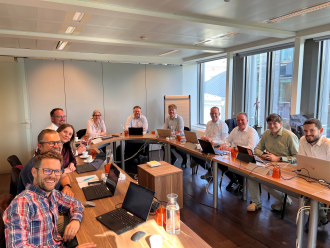
On 2 September 2026, the Agency participated in an in-person meeting, hosted by EIM (the European association representing rail infrastructure managers), addressing the ETCS System Compatibility (ESC) phase-out activities aimed at relaunching cooperation with the sector.
This meeting involved the key stakeholder associations, namely EIM, CER (the European association representing railway undertakings and infrastructure managers), UNIFE (the European association representing the railway supply industry), AERRL (the association representing European private railway infrastructure owners and managers) and ERFA (the European association representing independent and competitive rail freight and passenger operators).
As context, this meeting is the continuation of a topic launched through Article 12 of the CCS TSI 2023/1695, aiming to analyse how to phase out ESC checks. Between 2023 and 2026, several activities and initiatives were carried out, including a sector survey, workshops during the 2024 ERTMS Conference, an ERA recommendation report, and a Topical Working Group (TWG) held during 2025 involving all railway associations through several meetings. At the beginning of 2026, ERA once again took the initiative with a new action plan and a new approach for ESC.
The meeting on 2 September provided an opportunity to bring key stakeholders, represented by a limited number of delegates physically present, back together around the same table to work towards this objective. It allowed each organisation to restate its position and concerns regarding ESCs, as well as to propose a list of topics for discussion. ERA also detailed its approach, its 2026 activities, and its vision for making ESC checks more effective.
A key issue raised by ERA was the systematic association of ESCs with tests, even though they were originally defined merely as "checks". Conducting tests, whether in a laboratory or on-site, entails a range of challenges; the impact stems more from the fact that testing is required than from the sheer number of tests involved. Among the difficulties are access to testing facilities, waiting times, the availability of qualified personnel, costs, and testing authorisation procedures.
ERA’s proposed solution is twofold:
- First, to review the ESC specifications with the Infrastructure Managers (IMs) to understand the rationale behind them and shorten the list to only the necessary checks;
- And second, as an alternative to testing, to shift towards a "paper-based demonstration" approach, where ESCs would be addressed through "paper" scenarios describing the expected on-board behaviour with regard to transmitted information, questionnaires, or document checks. The IMs would have to set up scenarios or questionnaires describing the European Train Control System (ETCS) trackside implementation with a sufficient level of detail to allow a complete understanding, together with the driver actions, train movement details, and the expected ETCS on-board reaction. The ETCS on-board supplier would finally have to check the effective behaviour of its on-board system to demonstrate technical compatibility.
This meeting allowed the restoration of an efficient dialogue between the sector and ERA by aligning the sector's proposals with the ERA action plan, all sharing a common objective and leading to a roadmap for the way forward.
Even if the meeting was mainly focused on sharing visions and re-establishing cooperation, one major outcome and agreement was reached: in order to improve the reusability of results and to avoid the unnecessary repetition of ESC checks, the already existing option of performing ESC at Interoperability Constituent (IC) level is strongly supported and promoted as a key enabler for reducing ESC efforts.
As next steps, ERA intends to continue the ongoing activities as foreseen in its action plan, in line with the sector's key proposals to reduce ESC checks.
ERA is looking forward to continuing this constructive collaboration with the sector associations towards a common target.