
Image credit: © European Union Agency for Railways
ERTMS: from preaching to practice
Published: 24 April 2026
Updated: 09 September 2026
On Track with the Director
What a pleasure it was to be by your side throughout these three days of the ERTMS Conference – listening, exchanging, sometimes debating, and above all sharing a common sense of purpose with more than 600 participants in the room and many more online.
Now that, I hope, everyone has safely returned to their respective “home stations”, I would like to share a few personal reflections.
At the start of the conference, I introduced a metaphor that stayed with me throughout: ERTMS as a kind of technical religion. A slightly playful image, perhaps – but one that, in many ways, captures the journey we are on.
Because like any belief system, ERTMS began with a promise. In our case, a very concrete one: greater safety and increased capacity. These are not matters of faith alone; they are grounded in evidence, in engineering, and in the shared conviction of our community.
Then there is the “book” – our specifications. And as with many foundational texts, ours has gone through several editions. Not always smoothly. Early adopters – the true “pioneers of the faith” – embraced ERTMS when the text was still evolving. Their commitment has been essential, and it deserves recognition.
Today, we are entering what I would call a more “canonical” phase. A time for consolidation, for clarity, and for stability. If we want ERTMS to deliver on its promise, we must ensure that our rules are not only well written, but also consistently applied. This means moving towards real harmonisation – and, yes, occasionally resisting the temptation to add our own “interpretations” or local variations.
No religion, of course, exists in a vacuum. There are always earlier beliefs, long-standing traditions. In our sector, these are the legacy systems. And while they have served us well, maintaining multiple systems comes at a cost. If ERTMS is to become the common language of European rail, we must be ready – respectfully but decisively – to move beyond parallel “worship”.
One thing became very clear over these three days: ERTMS is no longer a theory, nor an experiment. It is already part of our operational reality. Drivers use it. Infrastructure managers rely on it. Investments have been made. There is no turning back – only the question of how we move forward.
And forward we must move – not only because we believe in the system, but because we are under increasing pressure. Legal deadlines, financial commitments, operational needs, political expectations, and global competition are all converging. If I may continue the metaphor, this is less about waiting for a “divine alignment of the stars” and more about recognising that the moment to act is already here.
This is why, in my closing remarks, I made a simple – almost modest – request to all participants: to leave the conference with one decision on what to stop doing, and one on what to start doing. No grand declarations. No distant horizons. Just concrete, immediate steps to simplify, accelerate, and deliver.
Because perhaps this is where the metaphor reaches its most important point.
We have done the preaching. We have built the community. We share the belief.
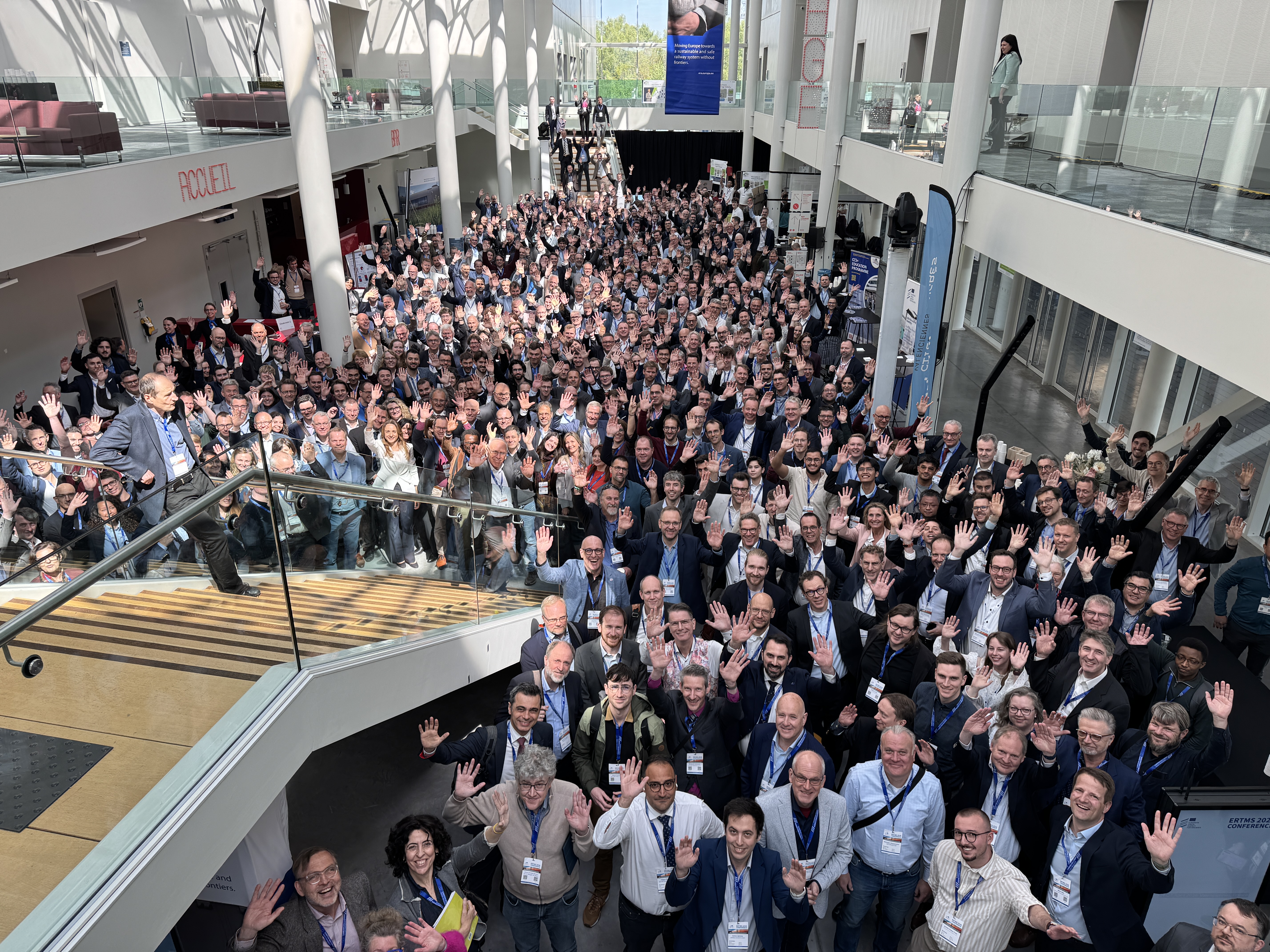
Now it is time for something more tangible – call it implementation, call it delivery… or, staying with the theme, perhaps even a form of collective conversion to action.
Together with the teams at the European Union Agency for Railways, I remain fully committed to supporting this journey – helping to turn alignment into progress, and progress into results.
ERTMS has all the elements of a European success story. It is now up to all of us to make sure that this story is not only told… but truly lived. Before the next ERA ERTMS Conference, let’s turn the current 15% deployment rate into a number that we can be proud of!
This article is part of On Track with the Director, offering a personal window into the thoughts, insights and experiences of Oana Gherghinescu, Executive Director of ERA.