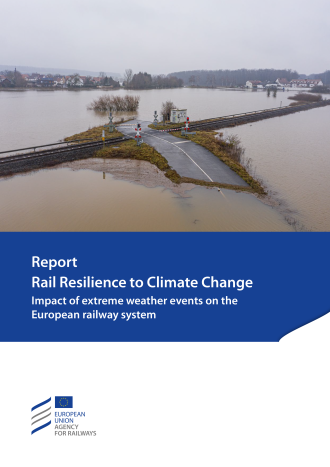
rail resilience to climate change report 2026 - cover.png

Rail Resilience to Climate Change

Published: 30 March 2026 Updated: 31 March 2026

Following the request from the European Commission, the Agency has published the first comprehensive assessment of extreme weather impacts on the rail system, together with six proposals to strengthen the EU legal framework regulating resilience to climate change.

Press release

Europe’s railways face increasing climate risks, but solutions exist. Following the request from the European Commission, the European Union Agency for Railways (ERA) has published the first comprehensive assessment of extreme weather impacts on the rail system, together with six proposals to strengthen the EU legal framework regulating resilience to climate change. 

ERA’s report provides the most complete picture to date of how climate hazards affect rail infrastructure across Europe. The report shows that 70% of EU infrastructure managers perceive increasing impacts of extreme weather on their networks (representing 79% of the EU network in track km). After data cleaning, 13.469 extreme weather events were identified for the 2005–2024 period, with a peak in 2018 and a clear upward trend over the last decade. 

Floods and heavy precipitation, windstorms and landslides are the most disruptive hazards for Europe’s railways. When looking at the cumulative impact, the total weather‑related delay of railway services recorded between 2015 and 2024 corresponds to an annual reduction to between one and three full years of railway service at EU level. Beyond operational disruption, recent events have led to severe localised damage. Publicly available national assessments report losses of around €65 million in Belgium (2021 floods), €1.4 billion in Germany (2021), €150 million in Italy (2023), approx. €450 million for the Athens–Thessaloniki line in Greece (2023), €212 million in emergency works in Spain (2024). 

Building on one year of data collection, modelling, consultation workshops and inter institutional cooperation, and drawing on a consolidated dataset covering nearly a decade of weather‑related disruption, ERA puts forward six proposals to strengthen the EU legal framework to improve rail resilience to climate change, that directly respond to requests from infrastructure managers, national authorities, European bodies and international organisations involved in drafting the report. 

  1. Common Safety Method for Assessing Safety Levels and Performance (CSM ASLP) introducing harmonised and mandatory reporting of weather related occurrences, through a common taxonomy and EU wide data environment.
  2. Common Safety Method for Risk Evaluation and Assessment (CSM RA) integrating climate risk and vulnerability assessments into the EU’s risk evaluation processes, aligned with ISO 14091 and EU climate proofing guidance.
  3. Technical Specifications for Interoperability (TSIs) for Operation and Traffic Management (TSI OPE) aiming at strengthening coordination requirements for contingency and crisis management during extreme weather events, including cross border mechanisms.
  4. Structural TSIs to analyse standards and verify the need for updates to integrate climate projections, notably for drainage, embankments, bridges, culverts, and environmental operating conditions.
  5. Role of National Safety Authorities (NSAs) and ERA in certification, authorisation and supervision, reinforcing how climate risks are assessed in safety certification, safety authorisation and supervision processes at national and EU level.
  6. Cooperation and knowledge sharing framework to establish a more structured EU level network to share best practices, data and methodologies - building on existing cooperation with EEA, EIB/JASPERS, UIC, ITF, Europe’s Rail and Member States.

To implement these proposals, ERA will continue working with the European Commission, Member States, NSAs, infrastructure managers and European bodies to refine them and support their integration into EU policy.

“A resilient transport system should go beyond immediate emergency response to the impacts of climate change. It should embed forward-looking planning, with adaptation at its core, to withstand increasingly severe risks, in particular floods, windstorms, landslides and wildfires. The Commission will continue to work with ERA, EEA and other relevant partners to ensure a coordinated and effective response across the rail sector.”

"Climate change is a measurable reality. Two thirds of European infrastructure managers see its impact on their networks today. Data, risk assessment and climate proofed investments are essential pillars for a resilient European railway system. As things stand, only 37% of infrastructure managers use climate projections to design new assets and less than half have comprehensive adaptation plans. The findings of this report underline the need to accelerate Europe’s shift from a reactive approach to a systemic, proactive and forward looking resilience strategy.”

“Europe's railways are part of our shared European identity, and we cannot afford to let them erode, due to climate change or other reasons. This report provides an essential baseline for understanding how extreme weather threatens our rail networks, and what it will take to protect them. The knowledge is now there; what matters is that it translates into action. The time to invest in resilient railways is now.”

Background information

About the Report

The study is based on contributions from infrastructure managers, national safety authorities, European organisations and partners such as the European Environment Agency (EEA), EIB/JASPERS, UIC, International Transport Forum, and national research institutes. This reflects the strong inter institutional cooperation required to equip Europe’s railways for a rapidly changing climate.

About the EU Agency for Railways

The European Union Agency for Railways was established in Valenciennes in 2004 and has more than 200 employees representing more than 22 European Member States. 

ERA has been providing EU Member States and the European Commission with technical assistance in the development and implementation of the Single European Railway Area. This comprises enhancing technical interoperability and harmonising rules, promoting simplified access for customers, developing a common approach to safety and safety culture, advising on telematics applications and ERTMS (European Rail Traffic Management System), monitoring National Safety Authorities and Notified Bodies and facilitating the exchange of information between the railway actors in Europe. 

Since 16 June 2019 the EU Agency for Railways is mandated to issue single safety certificates and vehicle (type) authorisations valid in multiple European countries and to ensure an interoperable European Rail Traffic Management System.

Press release

Press Release - Rail Resilience to Climate Change Report 2026

English (370.01 KB - PDF)
View